
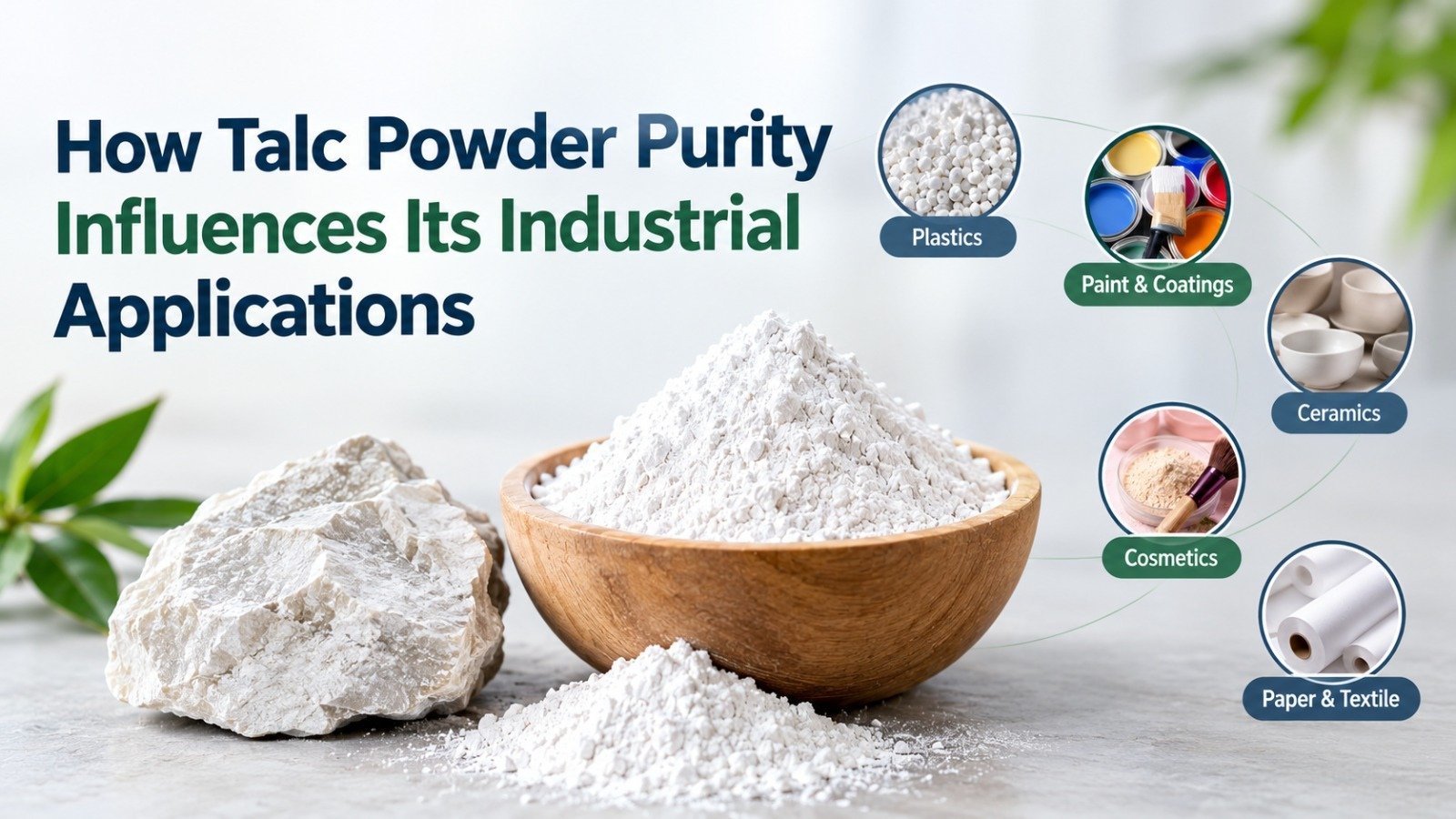
A talc bag might be the same in a warehouse, and be used very differently when used in connection with a plastic compound, paint batch, or a ceramic body. The difference typically is in the cleanliness of the product, that is, the proportion of talc to other ingredients. If you’re purchasing talc powder from suppliers, you’ve likely seen purity, whiteness and particle size listed on a spec sheet. This blog gives a description of those words and how they determine the location of the powder application.
What Is Talc and Why Does Purity Matter?
Talc is a soft, magnesium and silicon mineral, also referred to as hydrous magnesium silicate. Mined from rock and talc is not found in pure form. It is mostly binded up with other minerals like quartz, calcite, dolomite and chlorite. These are considered as impurities as they alter the appearance, feel and the performance of the powder.
This will vary depending on the job; the buyer should determine how much is acceptable. A cosmetic manufacturer requires a smooth powder, free of grit. Paints need to be dispersive and colour clean, which is what a paint maker is looking for. Brightness is a concern of a paper mill. Do not think that purity is only one number. It’s all about whether a specific grade is appropriate for the end use, which is why a buyer will verify the talc powder specification before ordering.
Talc Powder Specification: What Buyers Should Check
A talc powder specification usually covers a handful of points. Here is a simple way to read them.
Parameter | What it tells you | Why it matters |
Whiteness or brightness | How white the powder is | Affects the colour of the finished product |
Iron content | How much iron is present in the mineral | Iron dulls the white tone |
Particle size | How fine the powder is | Changes feel, flow and how well it mixes |
Grit and silica | Hard particles mixed into the powder | Can cause abrasion and a rough feel |
Moisture | Water held in the powder | Can lead to clumping during storage |
How Purity Changes Talc Powder Uses?
Talc powder is used in a variety of industries, with each industry having its own unique focus on purity.
Plastics:Talc is used as a filler for plastics. Cleaner, whiter grades help to maintain an even colour on the finished part.
- Paint and coatings: A fine, clean powder mixes smoothly. Rough finishes can be created by hard particles, such as silica.
- Ceramics: Talc is used in the ceramic body and glaze. A consistent quality will help as impurities will affect the behaviour of the material in the kiln.
- Paper, textile and rubber: Talc is used as a filler and helps with smoothness. It is better even if the particle size is uniform and brightness is good.
- Cosmetics and personal care: It’s the area where buyers are strictest. The powder should be white, soft and grit free.
- Foundry work: Talc is also used in moulding as a release powder to ensure a smooth and slippery surface on parts when they are removed from the mould.
In every case, the higher the purity requirement, the more closely a buyer should look at the grade before ordering.
Talc from Rajasthan and Udaipur: What to Look for in a Supplier
Udaipur is one of the talc mining districts in Rajasthan, India which is one of the primary regions of talc mining in India. Hence, buyers who are looking for talc powder manufacturers in Udaipur or talcum powder manufacturers in India are likely to find themselves looking at a state called Rajasthan. However, quality is not solely determined by the region. Sorting, grinding and grading done by the supplier are as important, and two powders from the same area may have different purity if they are ground in different ways.
This is where the supplier’s background counts. Snow Green Minerals has been in mineral supply since 1975. The company describes itself as a manufacturer and lists calcite, dolomite, quartz and talc in its range. Its website calls talc a versatile mineral with properties that suit a broad range of applications. For talc grade and specification details, buyers can contact the team directly with their requirement.
Conclusion
Purity has an impact on talc properties. It influences the color of the plastic component, appearance of paint, tactile sensation of cosmetic powder, and firing of a ceramic matrix. In advance, find the suitable grade according to your needs, review the specification details indicated above, and request a certificate of analysis. If you are selecting talc powder producers and need assistance in determining the appropriate grade, submit your application and volume of interest to the Snow Green Minerals company via their inquiry form.
FAQs
Q1.What does purity mean in talc powder
Basically, how much of what you’re buying is real talc. The rest consists of other minerals, including quartz or calcite, that were deposited with it. The less of that stuff, the whiter and smoother will be the powder.
Q2. Do all talc powder uses need the same grade?
No. A powder going into a cosmetic needs to be soft and grit-free. For a filler in rubber or paper, you can often work with a more basic grade. It depends on what the final product has to look and feel like.
Q3. Why do buyers keep asking about iron content?
Iron is used to decolorize talc with its white. If the powder is grey or dull, iron is likely to be a factor. It’s one of the first things to check for any product that relies on colour for its function.
Q4. What should I look at on a talc powder specification sheet?
Start with whiteness, particle size and iron. Then look at grit and moisture. Once you’ve checked those, compare them with what your process needs. A sheet that gives clear figures is easier to trust than one that only says “high quality”.
Q5. What should I ask talc powder suppliers before placing an order?
Ask where the powder will be applied, ask for a checking certificate, and request a safety data sheet. Ask how they check their talc if it’s going into a cosmetic or anything that comes into contact with skin.