
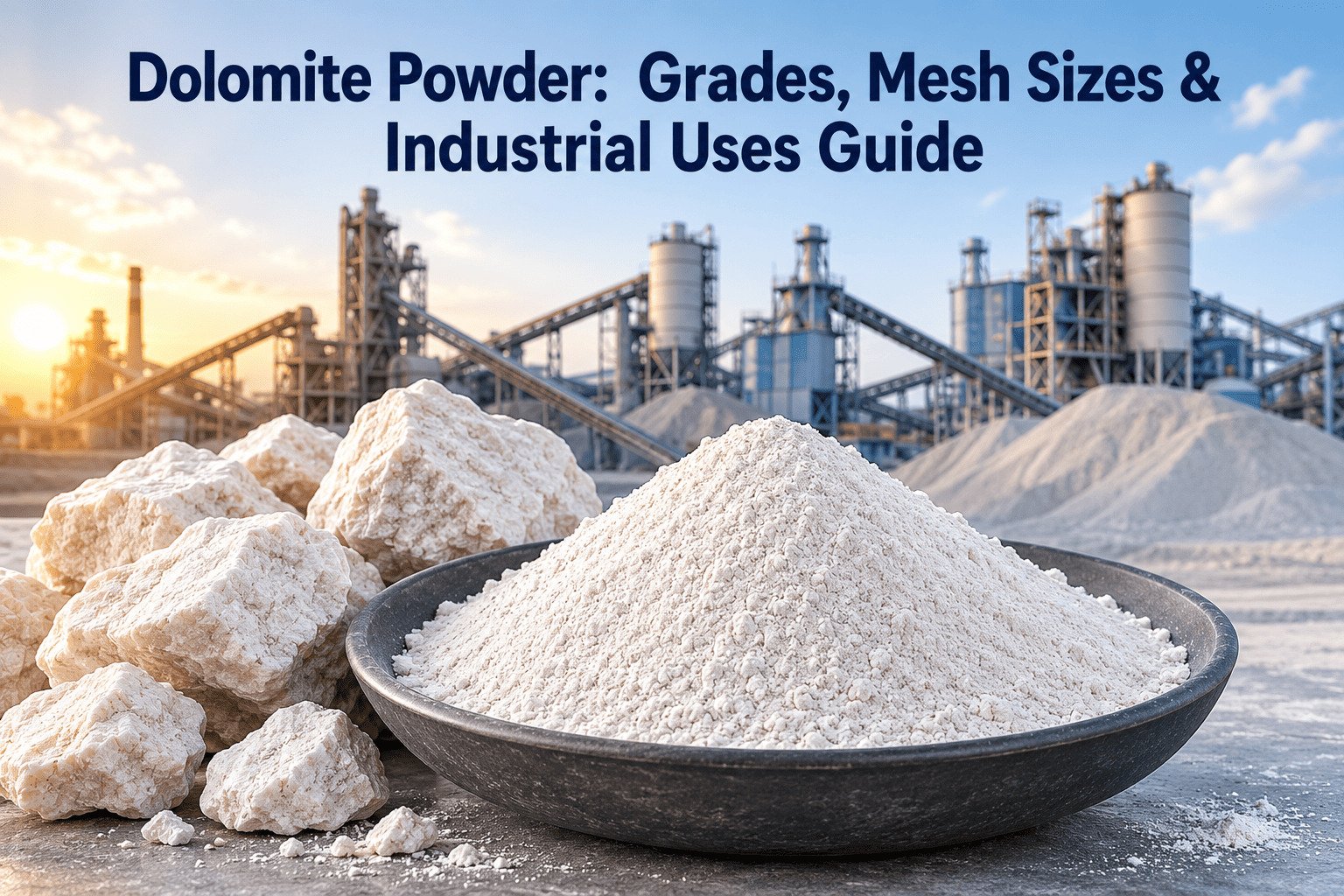
Dolomite powder is a naturally occurring calcium magnesium carbonate mineral
[CaMg(CO₃)₂] that has become one of the most in-demand
industrial minerals today. From construction to glass, rubber, paints,
agriculture, and soap manufacturing, its use continues to grow across sectors.
However, one common challenge most buyers face is choosing the right
grade and mesh size for their specific
application. In this guide, we break down every grade, mesh size, and industrial
use of dolomite powder
so you can select the right product for your business.
What Is Dolomite Powder?
Dolomite powder is produced by crushing and grinding dolomite rock into a fine
powder. It’s a white to off-white, odourless powder that dissolves easily in
water. Its chemical composition contains both calcium carbonate (CaCO₃) and
magnesium carbonate (MgCO₃), which sets it apart from calcite powder, which
contains only calcium carbonate.
This is exactly why dolomite powder is preferred in industries that also require
magnesium content, such as glass manufacturing, fertilizers, and animal feed.
Grades of Dolomite Powder
The grade of dolomite powder is determined by its purity, whiteness, and chemical
composition. Broadly, dolomite powder is classified into the following categories:
1. High-Grade Dolomite Powder (Premium Grade)
- Very high CaCO₃ and MgCO₃ content (98%+ purity)
- Minimal impurities (iron oxide, silica)
- Use: Glass industry, pharmaceuticals, cosmetics, high-end paints
2. Medium-Grade Dolomite Powder
- Purity level between 90–97%
- Slightly higher iron content
- Use: Rubber industry, plastics, ceramic tiles, paint fillers
3. Low-Grade / Commercial Dolomite Powder
- Purity up to 85–90%
- Cost-effective option
- Use: Construction, road base material, soil conditioning, agriculture
Tip: If you’re ordering for the glass or pharmaceutical
industry, always select a high-grade dolomite powder with iron oxide content
below 0.1% — higher iron content can cause discoloration in glass.
Dolomite Powder Mesh Sizes — Which Size Suits Which Application?
Mesh size indicates the fineness of dolomite powder — the higher the mesh number,
the finer the powder. This particle size directly determines the product’s
application.
| Mesh Size | Particle Fineness | Common Applications |
|---|---|---|
| 100–200 Mesh | Coarse | Construction, road base, soil amendment |
| 200–300 Mesh | Medium | Paints, plastics, rubber fillers |
| 300–500 Mesh | Fine | Ceramic tiles, PVC compounds, cable industry |
| 500–800 Mesh | Very Fine | Cosmetics, soap manufacturing, pharma |
| 800+ Mesh (Micronized) | Ultra Fine | Glass industry, high-end paints, coatings |
A higher mesh size means greater surface area, which improves binding, whiteness,
and smoothness — though it also comes at a slightly higher cost.
Major Industrial Uses of Dolomite Powder
1. Glass Industry
Dolomite powder is a key raw material in glass manufacturing. It improves the
mechanical strength, thermal resistance, and chemical durability of glass. Its
magnesium oxide content also makes the glass more crack-resistant.
2. Rubber Industry
In rubber compounding, dolomite powder is used as a filler. It increases tensile
strength and reduces production cost without compromising quality.
3. Paints & Coatings
As an extender pigment, dolomite powder improves the opacity, gloss control, and
durability of paints.
4. Construction Industry
Dolomite powder is an essential component in road construction, concrete
aggregates, and building materials, contributing to durability and load-bearing
capacity.
5. Agriculture
Dolomite powder is used as a soil conditioner to balance soil pH and correct
calcium-magnesium deficiencies, improving crop yield.
6. Soap & Detergent Manufacturing
Fine-mesh dolomite powder is used in soap bars as a filler and texture enhancer —
both cost-effective and skin-friendly.
7. Plastics & PVC
In plastic compounding, dolomite powder filler improves dimensional stability and
impact resistance.
8. Ceramic & Tiles Industry
In ceramic glazes, dolomite provides whiteness and thermal stability.
How to Choose the Right Dolomite Powder Grade
Before placing an order, make sure to check the following factors:
- Industry Requirement — What purity and mesh size does your
industry need - Whiteness Index — High whiteness is essential for cosmetic
and glass industries - Chemical Composition Report (COA) — Ask the manufacturer for
a lab test report - Moisture Content — Lower moisture content is better for
packaging and shelf life - Manufacturer Reliability — Always source bulk orders from a
trusted, established manufacturer
Dolomite powder is a versatile and cost-effective industrial mineral, but its
real value comes through when you choose the right grade and mesh size for your
specific application. Whether you’re in glass, rubber, paints, construction, or
agriculture, the right specification of dolomite powder can improve both your
product quality and cost efficiency.
Snow Green Minerals is a trusted, Rajasthan-based
dolomite powder manufacturer
supplying different grades and mesh sizes of high-quality dolomite powder for
glass, rubber, paints, construction, and agriculture industries. Contact us for
a customized quote based on your requirements.
FAQ
Q1. What is the difference between dolomite powder and calcite powder?
Dolomite powder contains both calcium carbonate and magnesium carbonate
(CaMg(CO₃)₂), while calcite powder contains only calcium carbonate (CaCO₃). This
extra magnesium content makes dolomite powder better suited for applications like
glass manufacturing, fertilizers, and animal feed.
Q2. Which mesh size of dolomite powder is best for paints and plastics?
For paints, plastics, and rubber fillers, 200–300 mesh dolomite powder is
generally preferred. It offers a good balance between fineness and cost, giving
smooth finish and good binding properties.
Q3. Is dolomite powder safe for agricultural use?
Yes, dolomite powder is widely used as a natural soil conditioner. It helps
balance soil pH and corrects calcium-magnesium deficiencies, which in turn
improves crop yield and soil health.
Q4. How do I check the purity of dolomite powder before buying in bulk?
Always ask the manufacturer for a Certificate of Analysis (COA) or lab test
report that states the CaCO₃/MgCO₃ percentage, iron oxide content, whiteness
index, and moisture content. This ensures the powder meets your industry’s
quality standards.
Q5. Why is dolomite powder used in the glass industry specifically?
Dolomite powder’s magnesium oxide content improves the mechanical strength,
thermal resistance, and crack resistance of glass. High-grade, low-iron dolomite
powder is used to avoid discoloration and maintain glass clarity.