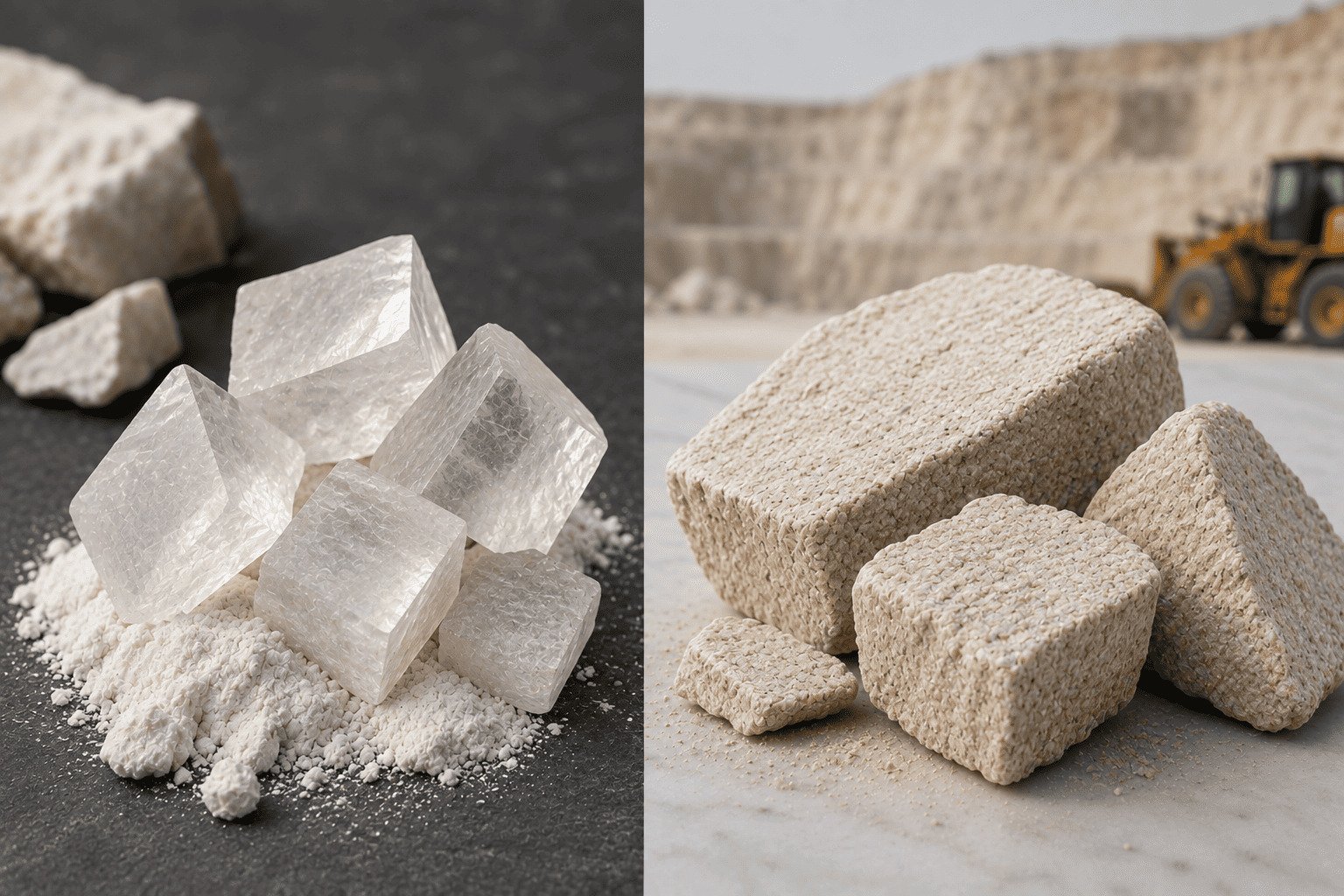
Rajasthan is home to some of India’s richest mineral belts, and two names come up again and again in industrial sourcing conversations: calcite and dolomite. Both are carbonate minerals, both are mined extensively across Rajasthan, and both are easy to confuse — yet they serve very different industries once processed into grains or powder.
At Snow Green Minerals, we’ve been sourcing and supplying calcite and dolomite from Udaipur since 1975, so this guide draws on decades of hands-on quarrying and processing experience rather than just textbook definitions. Here’s everything you need to know about calcite mineral, dolomite rock, dolomitic limestone, dolomite stone, calcite in Rajasthan, and how Snow Green Minerals fits into this supply chain.
What Is Calcite Mineral?
Calcite is a naturally occurring carbonate mineral with the chemical formula CaCO3 (calcium carbonate). It’s one of the most abundant minerals in the Earth’s crust and the main building block of limestone and marble.
Key identifying properties of calcite:
- Hardness: 3 on the Mohs scale (soft enough to scratch with a knife, not a fingernail)
- Colour: Colourless to white in its pure form, though iron and other trace elements can tint it yellow, pink, green, or grey
- Acid reaction: Fizzes immediately when a drop of dilute hydrochloric acid is applied — this is the standard field test for identifying calcite
- Cleavage: Breaks along perfect rhombohedral planes
Industrial Uses of Calcite
Calcite’s chemical purity and fine particle size make it valuable across a wide range of industries:
- Paints and coatings — used as a functional filler that improves opacity and gloss control
- Plastics and rubber — a cost-effective reinforcing filler
- Paper manufacturing — boosts brightness and printability
- Construction and cement — a core raw material
- Agriculture — used as agricultural lime to correct soil acidity
- Adhesives, sealants, and PVC compounds — improves consistency and reduces shrinkage
Snow Green Minerals supplies both calcite grains and calcite powder, processed to consistent particle sizes for these exact applications.
What Is Dolomite Rock?
Dolomite rock is a sedimentary carbonate rock composed primarily of the mineral dolomite, with the chemical formula CaMg(CO3)2 — calcium magnesium carbonate. It’s often mistaken for limestone because the two look similar at a glance, but the extra magnesium content in dolomite changes its behaviour and applications significantly.
The easiest way to tell them apart in the field: dolomite reacts much more slowly with dilute HCl than calcite does — usually only fizzing when powdered or when the acid is warmed. This slow-fizz test is a quick, reliable way to distinguish dolomite stone from calcite in a quarry or lab setting.
Practical Uses of Dolomite Stone
- Iron and steel manufacturing — used as a flux to help remove impurities during smelting
- Glass manufacturing — supplies the magnesium oxide component
- Ceramics and refractories — improves thermal stability
- Construction aggregates — used in road base and concrete
- Agriculture — as dolomitic lime, it corrects both calcium and magnesium deficiencies in soil, something pure calcitic lime cannot do
- Soap and detergent manufacturing — dolomite powder is increasingly used as a functional filler and mild abrasive
Snow Green Minerals’ dolomite grains and dolomite powder are quarried and processed to meet these industrial specifications, from steel flux grades to fine agricultural powders.
Dolomitic Limestone: Where Calcite and Dolomite Overlap
One term that causes real confusion in sourcing conversations is dolomitic limestone. This is a transitional rock that contains both calcite and dolomite, but with calcite as the dominant mineral (typically 50–90% calcite and 10–50% dolomite).
Property | Pure Limestone | Dolomitic Limestone | Dolomite Rock |
Dominant mineral | Calcite (CaCO3) | Calcite + Dolomite mix | Dolomite (CaMg(CO3)2) |
Magnesium content | Very low | Moderate | High |
Acid reaction | Fast, vigorous | Moderate | Slow (mainly when powdered) |
Typical use | Cement, construction | Agricultural liming, construction fill | Steel flux, glass manufacturing |
For buyers, the practical takeaway is this: if a project needs magnesium alongside calcium — for example, correcting magnesium-deficient soil, or a specific flux composition in metallurgy — dolomitic limestone or straight dolomite is the right call, not standard calcite.
Calcite in Rajasthan: A National Leader in Production
Rajasthan dominates India’s calcite production. According to the state’s Department of Mines & Geology, Rajasthan accounted for around 96% of the country’s calcite output and roughly 99% of gypsum production, ranking second nationally in overall mineral production value. Rajasthan also leads the country in silver, calcite, and gypsum production, and is the sole domestic producer of lead-zinc ore, selenite, and wollastonite.
The main calcite-producing districts in Rajasthan include:
- Sirohi — the largest producer, known for high-grade deposits
- Udaipur — home to some of the purest calcite deposits in the state, and where Snow Green Minerals is headquartered
- Dungarpur — significant reserve base
- Sikar — an important source of cement-grade calcite
Udaipur’s geology also puts it close to dolomite-bearing zones associated with the region’s lead-zinc belt, which is one reason suppliers based here — including Snow Green Minerals — are able to offer both calcite and dolomite from the same regional supply base.
FAQs
Q1: What is the difference between calcite and dolomite?
Calcite is pure calcium carbonate (CaCO3), while dolomite is calcium magnesium carbonate (CaMg(CO3)2). The quickest field test is a drop of dilute HCl: calcite fizzes instantly, dolomite reacts much more slowly.
Q2: Where does Rajasthan rank in calcite production in India?
Rajasthan is India’s leading calcite-producing state, accounting for roughly 96% of national output, with Sirohi, Udaipur, Dungarpur, and Sikar as the main producing districts.
Q3: What is dolomite stone mainly used for?
Its biggest industrial use is as a flux in steel manufacturing, followed by glass manufacturing, refractories, and construction aggregate.
Q4: Why is dolomitic limestone used in agriculture instead of regular limestone?
Because it supplies both calcium and magnesium, making it more effective for soils that are deficient in both nutrients, whereas regular limestone only addresses calcium.
Q5: Is calcite or dolomite better for paints and plastics?
Calcite is generally preferred in paints, plastics, and paper because of its fine particle size, brightness, and consistent chemistry, while dolomite is more commonly used where added magnesium content is useful, such as in soaps, detergents, and certain fillers.
Sourcing Calcite and Dolomite You Can Trust
Whether you need calcite grains for architectural applications, calcite powder for paints and plastics, or dolomite grains and powder for steel, glass, or soap manufacturing, sourcing from an established, Rajasthan-based producer matters — both for consistent quality and for supply chain reliability.
Snow Green Minerals has been quarrying and processing dolomite and calcite in Udaipur for decades. Get in touch to discuss specifications, grades, or bulk orders.