
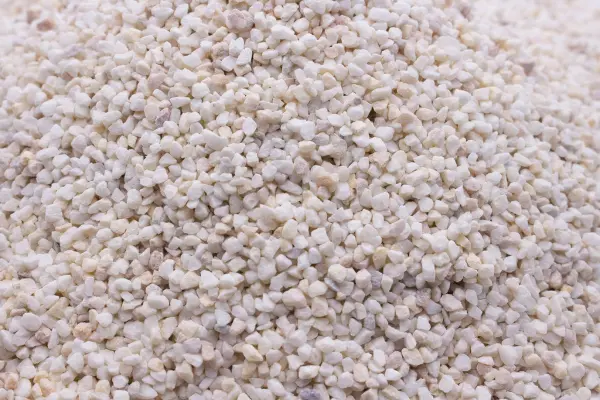
Dolomite Grains from Dolomite Rock & Dolomitic Limestone
Snow Green Minerals manufactures and supplies dolomite grains processed from dolomite rock sourced from Rajasthan’s mineral deposits. These grains go into glass manufacturing, paints, ceramics, rubber and construction, and each batch is tested against industry specifications before it’s packed in airtight bags to prevent contamination in transit.
Product Specifications
-
Chemical Formula: CaMg(CO₃)₂
-
Shape: Granules
-
Package Details: 50kg jumbo bags or customized packaging as per customer requirements.
What Are Dolomite Grains?
Dolomite grains are crystalline particles derived from dolomite rock — a formation known chemically as calcium magnesium carbonate, CaMg(CO₃)₂. Because it carries magnesium alongside calcium, dolomite rock is often described as dolomitic limestone, and that combined mineral content is what gives dolomite stone its particular value to manufacturers who need both durability and chemical stability in a filler material.
Colour Characteristics
Dolomite grains typically appear white to light grey, with minor natural variation depending on trace minerals present at the point of extraction.
Industrial Uses of Dolomite Grains
1. Glass Manufacturing
Improves optical clarity, transparency and overall glass strength.
2. Paints and Coatings
Functions as a filler that improves opacity, surface finish and coating durability.
3. Ceramics
Improves firing consistency and contributes to smoother, more uniform glaze finishes.
4. Rubber
Used as a reinforcing filler that improves mechanical strength and performance.
5. Construction
Used in concrete and asphalt mixes for improved load-bearing strength and long-term durability.
Physical & Chemical Properties
Chemical Formula | CaMg(CO₃)₂ |
Mohs Hardness | 3.5 to 4 |
Transparency | Opaque |
Lustre | Vitreous to pearly |
Specific Gravity | 2.84 to 2.86 |
Crystal System | Trigonal |
Why Dolomite Rock and Dolomitic Limestone Are Widely Used
The combined calcium-magnesium content found in dolomite rock and dolomitic limestone is difficult to match with a single-element mineral, which is why dolomite stone remains a preferred additive wherever manufacturers need material stability and process consistency.
FAQs
Q1. What is dolomite stone made of?
A naturally occurring mineral composed of calcium magnesium carbonate, CaMg(CO₃)₂.
Q2. Is dolomite rock different from limestone?
Yes — the added magnesium content is what distinguishes it, and is why it’s called dolomitic limestone.
Q3. What are dolomite grains used for?
Glass manufacturing, paints, ceramics, rubber and construction.
Q4. Why is dolomitic limestone used in construction?
It adds strength, stability and durability to concrete and asphalt mixes.
Snow Green Minerals supplies dolomite grains processed from dolomite rock and dolomitic limestone for industrial buyers across India. Contact us for bulk supply and customised specifications.